
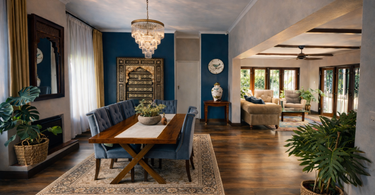
NIZARRA was commissioned to refine and complete the interior of a private residence in Parkhurst, Johannesburg.
The brief centred on creating a cohesive spatial narrative, working with an existing architectural shell and selected furniture pieces, while introducing clarity, warmth, and cultural depth.
The intervention focused on composition rather than excess, allowing each element within the home to feel intentional, grounded, and connected.
The Project
Project:
Parkhurst Residence
Type:
Residential
Location:
Parkhurst, Johannesburg
Scope:
Interior Refinement, Furniture Sourcing & Spatial Styling
Services:
Concept Design · Spatial Planning · Interior Styling · Furniture Sourcing · Art Direction

Design Thinking
The project explores the idea of quiet transformation.
Rather than redesigning the space, the approach was to remove visual noise and introduce structure through alignment, proportion, and material balance.
The dining area becomes the central anchor of the home, defined by symmetry, weight, and rhythm. The solid timber table, upholstered seating, and layered textiles establish a sense of permanence, while the chandelier introduces a vertical axis that stabilises the space.
African visual language is introduced with restraint.
Rather than decoration, it operates as spatial identity, expressed through pattern, geometry, and crafted surfaces.

Spatial Experience
The home unfolds as a sequence of connected yet distinct zones.
The dining space anchors the composition, while the adjacent living area softens the experience through light, texture, and openness to the garden.
Circulation is intuitive and uninterrupted, allowing movement between spaces to feel natural and fluid.
Moments of pause are introduced through focal elements - a central table arrangement, framed artwork, and sculptural objects, each positioned to guide the eye without overwhelming the space.

Material and Atmosphere
The palette is warm, grounded, and layered.
Timber surfaces establish depth and continuity, while soft textiles introduce balance and tactility. Neutral walls allow key elements to stand forward, particularly the deep-toned feature wall, which anchors the dining space and frames the carved panel.
Brushed brass and glass lighting elements introduce softness and reflection, enhancing the ambient quality of light throughout the interior.
Natural materials - wood, woven fibres, and ceramics, reinforce a sense of permanence and quiet luxury.


Cultural Expression
Cultural references are embedded with intention.
The interior reflects the dual heritage of the owners, Moroccan and South African, translated through material, pattern, and crafted detail.
A carved panel within the dining space introduces Moroccan craftsmanship, acting as both artwork and architectural anchor. Geometric artwork, inspired by South African (Ndebele) visual systems, brings rhythm and structure into transitional areas of the home.
These elements are not applied as decoration, but integrated as spatial language, grounding the interior in identity while maintaining a contemporary expression.

Outcome
The project results in a cohesive and grounded interior, where each element is aligned through proportion, material, and spatial clarity.
By working with existing furniture and refining the composition, the space achieves a sense of balance without excess, allowing the architecture and key elements to lead.
The integration of Moroccan and South African references introduces depth and identity, while maintaining a restrained and contemporary expression.
The result is a home that feels calm, intentional, and complete. Designed to be experienced over time.

