
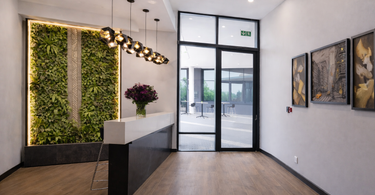
NIZARRA was commissioned to design the interior of a contemporary conference centre. A space intended to host dialogue, collaboration, and professional exchange.
The brief called for more than functionality. The space needed to feel calm, considered, and quietly distinctive. An environment that supports focus while subtly expressing identity.
The Project
Project:
Knightsbridge Conference Centre
Type:
Commercial Interior
Location:
Bryanston, Johannesburg
Scope:
Full Interior Architecture and Design
Services:
Interior Architecture, Joinery Design, Furniture & Art Curation, Lighting Specification, Biophilic Integration
Design Approach
A restrained material palette anchors the space. Warm timber flooring, honed stone surfaces, and dark structural elements allow form and light to define the experience. The reception desk acts as the central gesture, its angular geometry derived directly from the spatial footprint, reinforces a dialogue between plan and object.

Spatial Planning
Circulation and sightlines are structured to create clarity of movement and a calm arrival experience.
The reception establishes immediate orientation, with spaces flowing seamlessly into conference and breakout areas.
The planning prioritises intuitive way-finding, visual continuity, and a balance between openness and enclosure.


Joinery and Form
Custom joinery was developed as an architectural extension of the space. The reception desk is conceived as a sculptural element - monolithic yet precise, with a cantilevered stone surface that introduces both visual lightness and structural clarity.
Its geometry is not arbitrary; it is extracted from the underlying plan, translating spatial logic into built form.


Lighting Moment
Lighting is treated as both function and focal point.
Geometric pendants introduce rhythm and warmth, contrasting with the restraint of the architectural envelope.


Furniture and Atmosphere
The spatial language extends beyond reception, maintaining continuity through circulation spaces and curated elements.


External spaces extend the user experience, reinforcing a connection between interior function and landscape.

The project is resolved as a cohesive system where architecture, interior, and object are inseparable — balancing precision, warmth, and clarity.
